


Beyond the Dashboard: Turning Credit Union Data into Measurable Outcomes
Unlock the potential of credit union data by transforming insights into measurable actions and outcomes for growth and member engagement.
3 min read

The following is an article written by Rise Analytics' Director, Strategic Consultant Payments, Aris Jerahian. It originally appeared on CUInsight.com. John Wagner, Director, Strategic Consulting Lending is a co-author of this article.
Recent headlines about a proposed 10% credit card APR cap have reignited debate around fairness, affordability, and access to credit. Whether or not this specific proposal advances, the broader signal is clear: consumer credit pricing is under increasing scrutiny, and expectations around transparency and fairness continue to rise.
For credit unions, this moment isn’t about reacting to politics. It’s about preparing for uncertainty and leading with data-driven clarity—both internally and with members.
Flat rate caps make compelling headlines, but consumer lending is rarely simple. Unsecured revolving credit carries varying levels of risk based on credit history, utilization behavior, income stability, and broader economic conditions. Pricing reflects those realities, along with capital, fraud, and operational costs.
When pricing can’t adjust to risk, credit unions face an unavoidable tradeoff: absorb losses on higher-risk lending or restrict access altogether. In practice, that often leads to tighter underwriting, lower credit limits, pressure on rewards programs, and reduced access for credit-building members. Ironically, the very members these policies aim to protect are often the first to lose access to mainstream credit, potentially pushing them toward higher-cost, less regulated alternatives.
This is where credit unions can differentiate themselves, not by defending a specific APR, but by demonstrating thoughtful, data-backed decision-making that keeps member welfare at the center of every strategic choice.
Rather than debating hypotheticals, credit unions can use loan analytics to translate policy uncertainty into concrete operational insight. Scenario modeling allows leaders to evaluate key questions before any regulatory change occurs. It provides answers to questions such as how a flat 10% cap would affect approval rates across risk tiers, which member segments would lose access first, how would yield compression impact rewards funding and portfolio cross-subsidization and what happens to delinquency and charge-off patterns when pricing flexibility is constrained.
Beyond scenario testing, profitability modeling that quantifies how pricing changes ripple across portfolios, risk tiers, and member segments, moving the conversation from theory to numbers can aid in planning and decision making.
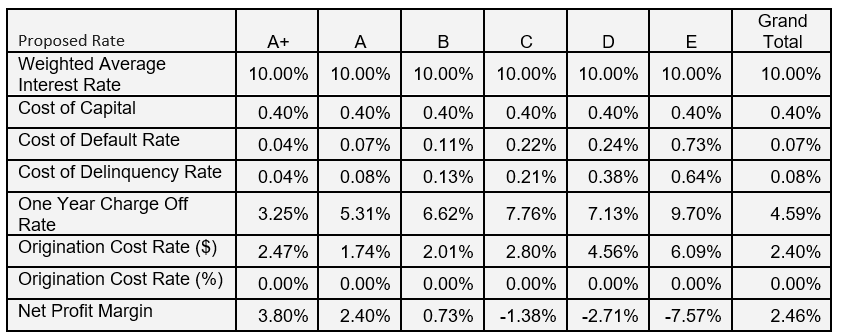
The tables below illustrate a real-world portfolio comparison between current risk-based pricing and the same portfolio modeled under a flat 10% APR cap. This view enables leaders to quickly assess margin compression, risk exposure and access implications before any policy shift occurs.
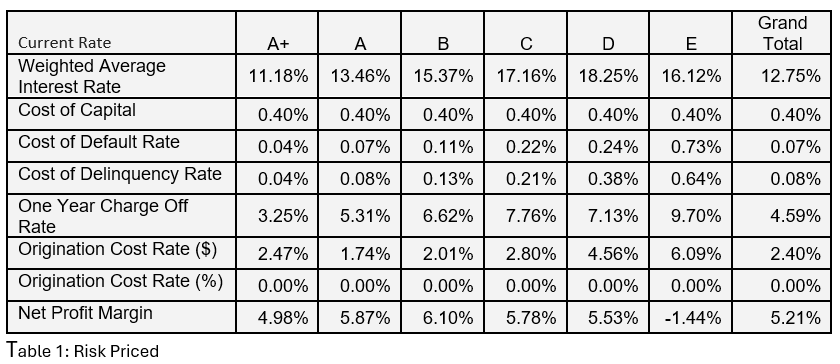
Under risk-based pricing, nearly every credit tier generates a positive margin, supporting a sustainable model that serves members across the credit spectrum while maintaining institutional health.
Under a flat 10% cap, that balance breaks down quickly. Credit tiers C, D and E shift from marginal profitability to material losses, driven by higher default rates and higher servicing and underwriting costs that a capped rate cannot absorb.
The implication is straightforward: credit unions cannot sustainably offer products that lose money with each transaction. The likely outcome is reduced credit limits, fewer approvals or the elimination of certain card programs for higher-risk members. Instead of improving access, a uniform cap risks narrowing it, particularly for members working to build or rebuild credit.
Public concern around rate caps often stems from the perception that lenders act too late, intervening only after members are already in financial distress. Advanced analytics give credit unions a fundamentally different path.
Behavioral and transaction-level insights can surface early warning signals traditional metrics miss: members shifting from transactors to chronic revolvers, rising utilization paired with declining payment consistency, spending pattern changes that suggest stress, or shifts in payment timing that indicate cash-flow challenges.
With this visibility, credit unions can act earlier, adjusting credit lines to prevent over-extension, offering refinance or consolidation options to reduce payment burden, delivering targeted financial education at moments of highest relevance, or guiding members toward alternative products better aligned with their current situation.
The goal isn’t to maximize interest income from struggling members. It’s to keep members safely engaged in the financial system, building financial capability while managing risk responsibly. This is fairness in practice.
Analytics answer the what by revealing patterns, risks, and opportunities. Strategic consulting answers the now what by translating insight into coordinated action.
Lending-focused consulting helps credit unions align pricing philosophy with risk appetite and member mission, convert scenario results into practical underwriting and policy decisions, and prepare clear, data-backed narratives for boards, regulators, and member communications.
At the same time, consumer credit doesn’t exist in isolation. Card pricing decisions affect rewards sustainability, interchange revenue, and member spending behavior. Payments-focused consulting adds a critical complementary lens, helping credit unions understand how changes in card economics influence engagement, channel usage, and broader relationship growth.
Together, lending and payments consulting support an enterprise-wide approach, ensuring decisions around rates, underwriting, rewards, and engagement are coordinated rather than siloed.
Broad APR caps would require legislative action and face significant legal and regulatory hurdles. There is no immediate rule change underway, but waiting isn’t a strategy. Scrutiny around credit pricing is real, and expectations around transparency and fairness will continue to evolve.
The most effective response isn’t reacting to headlines: it’s preparation. Credit unions that combine analytics with strategic consulting can replace speculation with clarity, using data to protect access, manage risk, and reinforce member trust.
The regulatory landscape will keep changing. Member expectations will keep rising. Credit unions that prepare now with data, strategy, and a genuine member focus will be ready to serve their communities, no matter what comes next.

Unlock the potential of credit union data by transforming insights into measurable actions and outcomes for growth and member engagement.
Discover how Rise Analytics' 2026 updates empower credit unions with AI-driven insights, enhanced member intelligence and improved data governance.

How credit unions can navigate inflation and high interest rates by managing loans, reserves, and refinancing programs to retain and attract members.